 Alan Couzens, MS (Sports Science)
A little addendum to my Endurance Corner article on ‘basic limiters’ today(http://www.endurancecorner.com/Alan_Couzens/basic_limiters) to address a ‘sort of’ basic limiter – movement economy.
In the article, I defined ‘basic limiters’ as those oft ignored elements of performance that are crucial to all athletes (and maybe all human beings) independent of whatever sport they participate in. In summary, those basic limiters are:
· Aerobic Base (Metabolic Fitness)
· Basic Strength
· Mobility/Stability/Muscle Balance
· Basic Strength
· Mobility/Stability/Muscle Balance
I half considered adding a 4th basic limiter of movement economy to the equation but it didn’t quite make the cut for the EC article so it wound up here on my personal blog :-) This is the ‘almost a musketeer’ limiter in the sense that while it has some elements that are specific to the individual’s sport, it is a general limiter in the sense that no matter whether your event lasts 2 seconds or 2 days, your ability to transfer metabolic energy into forward movement in the most efficient, economical way possible is a crucial ability.
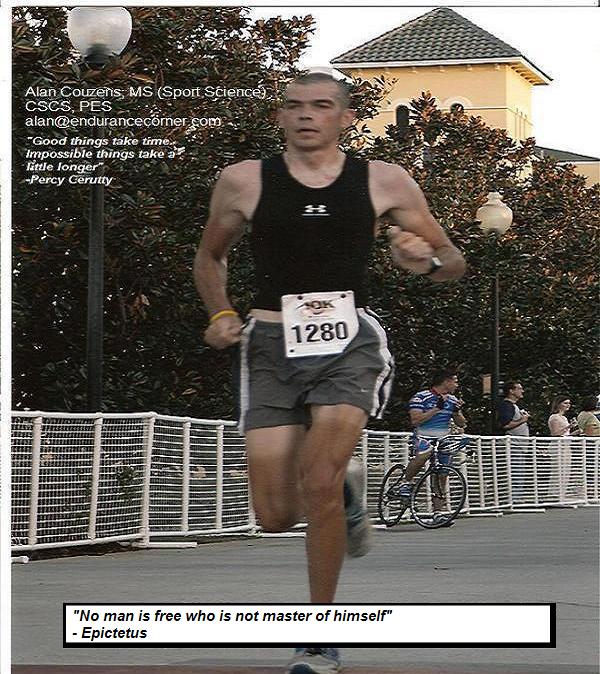
This ‘sort of’ basic ability is made all the more tricky by the fact that many of our most basic movements are, when you break them down, incredibly complex. Take running for example, an economical run stride demands setting the body in the optimal position to utilize the elastic energy of the tendons coupled with an incredibly complex sequencing of rapidly contracting certain muscles while relaxing others so that inter-muscular resistance is minimized.
Swimming is even more of a mess. Not only must the timing of the optimal contract-relax sequences be figured out, but due to the nature of the resistance, the most economical type of stroke changes with different speeds of movement! Having a longer vessel (and maybe even a slight pause in the stroke) becomes progressively more important with increasing speed.
Contrast these with the relatively simple sport of cycling or basic lifting (which both have a much more steady application of force) and you see how there can be quite a discrepancy between 2 equally ‘powerful’ athletes on the bike (or gym) when it comes to swim and run speed/economy for a given output.
You may be movement economy limited if….
If I were a comedian I’d go Jeff Foxworthy at this point but I’m an exercise scientist so straight to the data…
· Your 30s power on the bike is >7w/kg and you can’t break 30s for a 200m run sprint.
· You can do 12 pull ups in 30s but can’t break 30s for a push start 50m freestyle sprint.
Note: I’m deliberately using short (non specific) tests here to take out the complicating factor of aerobic vs movement economy in longer tests, i.e. fitter athletes will get more mechanical work out of each liter of O2 independent of their movement economy (Coyle et al., 1991)
· Your 30s power on the bike is >7w/kg and you can’t break 30s for a 200m run sprint.
· You can do 12 pull ups in 30s but can’t break 30s for a push start 50m freestyle sprint.
Note: I’m deliberately using short (non specific) tests here to take out the complicating factor of aerobic vs movement economy in longer tests, i.e. fitter athletes will get more mechanical work out of each liter of O2 independent of their movement economy (Coyle et al., 1991)
If you think that movement economy may be a limiter for you…
Incorporate things that teach you to get movement from quick force application followed by relaxation both in the water & out – Light Plyometrics (upper and lower), Agility Drills (dryland and aquatic – learn to accelerate!), Kettle bell/Medicine Ball Work, Jump Rope.
Note that movement economy is also contingent on mobility. For example in running, even if you’ve learned to switch the hip flexor off during the drive phase of gait, if you come up on the limits of your flexibility, it will slow you up!
Mobility is even more of a limiter to economical swimming. If you want to be fast as an adult athlete (over any distance/sport) get a basic level of mobility!
If you suspect that economy may be a limiter, the early season is the perfect time to work on these core issues of mobility & learning to move efficiently.
Train Smart,
AC.

