Thursday, May 29, 2008

Improving Fat Oxidation

Part 1: What Science Says....


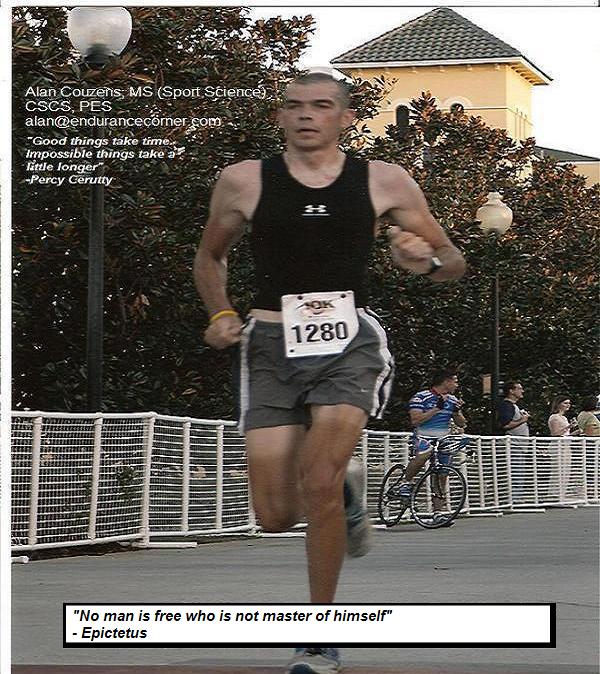
The pic above is of yours truly following the completion of the Triple T triathlon in Ohio this past week. The photo was taken on the last day, after about 5K of swim racing, 190K of bike racing and 43K of run racing. I was a little depleted to say the least (G can attest to that by the way that I was walking after the race :-)

My strategy for the race was (I thought) a pretty conservative one: Hit the prologue pretty hard (about 90% of max effort), take the second day, 2 olympic distance races, as a regroup day by racing steady (150 heart rate cap) then try and race day 3 at mod-hard, which is just a notch below where I would race a fresh half (mod-hard to hard). I discussed G’s race plan with him in the car. He wanted to shoot for the lead early in the prologue and first oly. So, basically, his plan was to go hard from the gun. As it turns out, he had to continue to go hard pretty much until the last run in order to ensure the W. When I say hard, I mean hard in every sense of the word. Physiologically, if he were to go any harder he would be limited by lactate accumulation in the same way that an 800m runner is. G was racing very close to his max all weekend long. So, how did my conservative strategy play out? Great, until the second lap of the bike on Day 3 when I dropped from holding 280W to less than 200W in one fell swoop. Bonktown, population…me! Fortunately, my stupidity was transient. I went into damage control pretty quickly when I saw the writing on the wall. The second lap of the bike was very easy (13 minutes slower than the first) and by the time the run came around, I had a little bit of steady back to play around with. Yet again, the gap between G’s performance and mine became Grand Canyonesque as the race duration increased. I was forced to race so far below my max in order to just survive the weekend, while G was able to push his max day after day. Why? My arch enemy, Captain Fat Oxidation rears his ugly head again.

This post is going to be a little different to my previous posts on fat oxidation. Hopefully by now, you’re as convinced as I am that the ability to utilize fat as a substrate is an important, distinguishing factor between those who excel at Ironman and those who, despite impressive short course results, are unable to put it together for ‘the big one’. Hopefully, you’ve already contacted Matty Stein and booked a testing slot at our Endurance Corner lab in Boulder to determine whether fat oxidation is limiting for you. No, this post isn’t for the fence sitters waiting for academia to catch up before making a decision as to whether to devote their time toward improving this physiological variable. Nope. This post is for those athletes who have gone through the testing, identified that fat oxidation is a limiter and who are ready to roll up their sleeves and get to work on turning yourself into a fat burning machine.


So, this first post is going to give you a little background reading on what science says about means and methods to improve your ability to utilize fat as a fuel. My next post will be entitled “Fat Oxidation….What Big A says” and will profile some of the improvements that I have seen in my own athletes and the training and nutritional methods that we have used to achieve them.


But first….


You know how most folks have a favourite actor or actress? An actor that, if they come out with a new movie, you just have to see it? Well, in the same way that you may be a huge fan of your favourite movie star, I am a huge fan of a sports scientist by the name of Julia Goedecke. Julia’s chosen ‘genre’ is the influence of fat oxidation on long distance racing performance.


Julia and her colleagues at the Sports Science Institute of South Africa conducted a study in 2000 that looked at individual differences in fat oxidation across a variety of exercise intensities (rest, 25%, 50% and 70% VO2max). She came to a number of conclusions that have practical implications for ultra-endurance athletes:


#1. There is a wide variation in the amount of fat that is oxidized at rest.


Some of the athletes were deriving almost 100% of their resting energy from fat, while others were only deriving 25%. This has HUGE implications on athletes who struggle with body composition. By increasing your rate of fat oxidation at rest, you could potentially lose body fat 4x faster than you currently are!!! Not to mention preserving your precious glycogen stores for your next training session.


#2. Those subjects who burned more fat at rest also burned more fat at ALL EXERCISE INTENSITIES (see chart)


Even at 70% VO2max, some of the subjects who were 100% fat burners at rest were still deriving 40% of their energy from fat (think G), while in the athletes who were poor fat burners at rest, fat burning had completely shut down (think me, or you??)


So, what were the distinguishing factors between the ‘corvette’ athletes and the ‘prius’ athletes? Interestingly the factors changed somewhat with increasing exercise intensity.


a) The concentration of Free Fatty Acids within the blood


This is THE pre-requisite for fat burning at rest and all exercise intensities. In other words, if your blood is full of glucose as opposed to FFA’s, you will not be providing the muscles with any stimulus to ‘learn’ to use fat as a fuel. High FFA levels (and low-moderate blood glucose levels) are a pre-requisite for fat burning. This has LARGE nutritional implications. If you keep your blood sugar levels perpetually elevated, you will never become a fat burner. Period.


b) The concentration of fat-burning enzymes within the muscle.


While short chain and medium chain FFA’s can diffuse into the mitochondria freely, long chain FFA’s must ‘hitch a ride’ with the enzyme carnitine palmitoyl-transferase in order to make it to the mitochondria. A shortage of this enzyme will mean that even if you have sufficient FFA’s within the blood, the long chain ones will be left by the side of the road with their thumb in the air waiting to hitch a ride. This enzyme is inhibited in the post absorptive state when blood glucose is elevated.


c) Mitochondrial content within the muscle.


Of course, in order for FFA’s to be ‘burned’ and used for fuel we need a sufficient number of ‘engines’ to burn them. In this sense, the number of mitochondria within the muscle can ultimately limit the rates of fat oxidation. This is a function of aerobic fitness, which in turn is a function of the number of contractions performed by each muscle fiber, or put another way, as my buddy Chuckie V is fond of saying, miles make champions.


So, there you have it – 2 simple ways to turn yourself into a fat-burning machine:


1. Cut sugar from your diet (and moderate total CHO intake)


2. Train MORE in your aerobic zones (cut out the hard stuff until you’re ready for it).


Not exactly earth-shattering revelations, but based on what we are seeing in the lab these 2 principles are not being applied by most athletes. You can beat a large portion of the field by making these simple (though not easy) changes.


I’ll get down to more specifics in the next post.


Train smart.


AC.
Update:

Benzing asks:


“I have been tested and my suspicions confirmed that I am about as inefficient as possible. Is there any data on how long it takes a 44 old female body to retrain itself when practicing the prescribed training and change in diet?”

There has been a good amount of research on the physiological effects of low and moderate carbohydrate diets (e.g. Ravussin et al, 1985, Weinsier et al, 1992). Generally speaking, individuals who adopt a low-moderate CHO diet can expect a change in their resting RQ of ~.05 within 12-16 weeks. This translates to an increase in resting fat oxidation of ~20%.

The extent to which this carries over to performance during exercise is dependent on your overall fitness, or how many ‘engines’ you have to process your new found fuel line. This is the reason that studies looking at the impact of training on fat oxidation have returned mixed results. Keep in mind however, that even for the relatively unfit, burning more fat at rest is still a good thing!!

The vice versa argument also applies, as we found while driving the Sportsmobile back across the country from the Triple T. You can have the largest capacity tanks and the biggest engine around, but until you pay the lady at the gas station and she turns the fuel pumps on, the number of miles that you’re going to be able to drive is severely inhibited. :-)

Thursday, May 15, 2008

Big A challenges YOU to a drag race!!

Pick your weapon of choice:
Option 1: A 2008 Corvette Z06


Option 2: A 2008 Honda Accord
Option 3: A 2008 Prius Hybrid


Now remember, this is a race. Make your selection.

I’ll tell you what, while I love driving in general, I have a bit of a penchant for long distance driving, so let’s race from my home town of Boulder to Albuquerque, NM, OK (about 350mi)?

There’s one more condition to the race, to keep things fair (and authentic to triathlon) we start with our gas tanks full and do it on one tank of gas. Thinking of changing your selection yet? No? You’re right, it’s still a race, whether it’s 50mi or 500mi, the fastest guy wins in the end, right?

OK, so let’s play it out. You screech out of the Boulder Res using every bit of your 505 Horsepower (in triathlon speak 376,000 Watts at VO2max, or in relative terms, you’re making Lance Armstrong’s 6.7 W/kg look pretty pathetic with your 265 W/kg :-) . You hit a solid cruising speed of 140mph (only 70% of your max!!) and you’re thinking this is cake. You’ve got the win in the bag. You’re passing cars left right and center – zing, zing.

Your buddy in the Accord takes off too at about 100mph (70% of his max) and he’s losing ground fast. You’re thinking to yourself, I bet he’s wishing he had those extra 143W/kg right now. Right?

Meanwhile, driving Miss Daisy takes off at a snails pace in the Prius at 80mph (70% of her max). Things aren’t looking great for her as the two guys scream off toward the Horizon. Honestly, with her 44W/kg she’d be better off enlisting the help of 6 Lance Armstrong’s with FT’s of ~ 7W/kg to pull her along dog sled style!! :-)

So, things are looking pretty clear cut as you scream along I25 toward Albuquerque, but then as you approach about 320mi, all of a sudden your super sexy sports car isn’t sounding so super sexy. You try and try to keep her going, but before you know it, you’ve got your head in your hands at the side of the road as your buddy in the accord (with 140W/kg less top end than you) comes rolling by. Doesn’t make sense, you both started with same size fuel tanks (18 G) topped off. Oh well, nothing you can do about it now but drop out of the race or get behind your car and push at a ridiculous crawl.

You’re no quitter, so as you tramp out the miles in the desert heat you get to thinking. “What went wrong?” It’s not too long before you put 2 and 2 together. Same size tanks, one guy runs out of gas before the other, man, that accord must be a lot more efficient with his fuel. You’re right. The accord is getting 22miles from every gallon of glycogen (oops, I mean fuel :-) whereas you and your sexy beast are getting 4 miles less for every gallon. As the buzzards start to circle, you get to thinking, “Gee, if fuel economy is the name of the game, Miss Daisy in the Prius is looking mighty good right about now.”

You’d think so, wouldn’t you? But the fact remains, with her pretty pitiful 44W/kg and her equally unimpressive top end speed of 115mph, Miss Daisy just isn’t going to have the Horsepower to catch the accord within the 350mi. She’ll get there, to be sure (and a whole lot faster than any of the clowns who wind up running out of gas and pushing) but at 80mph it’s going to take her about an hour longer than it takes your former buddy (who didn’t stop to pick you up – hey, it’s a race :-) in the Accord.

Believe it or not, this story isn’t just a case of Big A sitting on his couch spinning a yarn. Like all good parables, there is a strong hidden meaning in this story. Let me point it out for you: If you’re a Corvette (see below)


and you decide that this long distance racing thing is for you, spending training time eeking out another 10 horse power from your top end isn’t going to do much for you.


Likewise, if you have more of a Prius profile (see below), a dose of long steady distance training designed to improve your efficiency isn’t going to help you compete with the big boys come race day.

It is essential that in order to get to the next level, you determine what your true current limiters are. I see a lot of triathletes training blind in this regard. The only real way to determine whether you are a Prius or a Corvette is to take a FUEL test.

If you’re anything like the athletes that we’ve tested to this point, you may be surprised with the results.

Tuesday, May 13, 2008

Decisions, De-cisions

“Do or do not. There is no try.”
- Yoda

The pic above is of Hernan Cortes. Cortes’ greatest claim to fame (at least from my perspective) was the famous incident at Vera Cruz, when, during his attempted Mexican conquest, after landing on the shore with his armies and hearing of the might of the local ruler, Montezuma, he made the decision to eliminate any chance of retreat by burning his army’s ships.

The word decision comes from the latin roots ‘de’ meaning ‘from’ and ‘caedere’ meaning ‘to cut’. In other words, making a true decision means to physically cut yourself off from the possibility of failure.

Do not fool yourself, we all have limits to our will power, as Gordo points out in his latest blog. It is not superior willpower that separates champions from the rest of us. I spent a good amount of time with the Aussie national swim team when I was back in Australia. Like any sample of society, there are a number of different personalities within the team. Some are “hard” as a rock, completely unyielding, thinking about swimming and their goals for the sport 24-7. Others are more ‘soft’, more ‘yin-yang’ athletes, a balance of ‘get down to business’ attitude when they hit the water and ‘regular guy time’ when they hit dryland. Personality is not the distinguishing factor that separates those who make it from those who don’t. So, what does separate achievers from non-achievers? Achievers put themselves in a position to make habits of the things that failures won’t do. To be real, in the world of swimming, it is often not the athlete who must summon the daily willpower to make these decisions.

I never really ‘made it’ as a swimmer. I was an above average local swimmer. I’d pick up some medals at local meets. I made a couple of representative meets but there were certainly other swimmers in my own squad that were at that next level. Some went on to make the Aussie national team. When I look back to what the difference between them and me was, I am forced to conclude that the biggest difference wasn’t in their own obsession for the sport. Rather, these athletes had parents that were OBSESSED with the sport. On occasion, when one of these swimmers put in an effort that was deemed to be ‘sub-par’, I have seen his mother slap the kid across the face when he got back from his race. When I started coaching elite juniors in Sydney (8-12 year olds that were the superstars of tomorrow) this level of parental ‘commitment’ was no longer the exception, it was the rule.

It’s an interesting position to be a coach in this situation. While I knew that these kids were missing out on having a loving, caring, soft parental figure, they were gaining something that I never had, the joy that comes with being the very best, but more than that, the joy that comes with becoming your very best.

Now, I want to make clear that I am in no way condoning corporal punishment, especially in this circumstance. However, I do want to say that in some ways I wish that my parents would have pushed me more to stick to a commitment that I made.

This reminds me of the story of world record marathoner Toshiko Seko. After a particularly tough stretch in (his coach) Nakamura’s training camp, in which Nakamura put Seko on a diet of a piece of toast and a piece of lettuce each day (notably, in an effort to lose the weight that he had put on after spending some time in the US college system), Seko broke and ran home to the perceived security of his parent’s abode. When he got there his parents closed the door on their son. The sent him back to Nakamura with a message “Do whatever you must with him: He’s yours”.

OK, so maybe we aren’t all willing to make those decisions; to convince one of our family or friends to beat us up every time that we don’t make a performance benchmark or to live on lettuce and toast in an effort to lose a few pounds, but the point remains that the laws of cause and effect apply to us all and that if you are not receiving the results that you want in your life, it is because you have not made the decision to put these causal, environmental factors in place.

A true decision is marked by a physical action, the physical action to, all extents possible, block off any source of retreat. This may mean throwing all simple sugars in your home in the bin. It may mean selling your car so that you are forced to commute by bike. It may mean joining a masters swim program so that you have a social burden to show up to your swim sessions. Whatever the action, it is important to note that we live in a society in which retreat is both easy and, to some extent, expected (think divorce rates), and in which a decision, like a New Years Resolution is rarely worth the paper it is written on (if indeed we even get to the point of writing it down). It is not a true decision until it is backed up with massive, immediate action.

BURN THOSE SHIPS!!!

Monday, May 5, 2008

True Limiters


“First learn stand, then learn fly. Nature rule, Daniel-san, not mine.” - Mr. Miyagi

I was watching the Karate Kid yesterday. It’s been a while since I watched that movie and I must say that viewing it this time through the filter of a coach was a little different experience – that Miyagi knows his stuff! 

I thought I’d open with one of his gems from the movie. So true. I’ve already written a number of blog posts along a similar line, i.e. you must first get fit before you get fast. I have outlined just how much time some of my mentors in the swimming world devote to building their swimmers aerobic engines before any thought of adding “speedwork” to the program.

As an aside, from my own experience, I recently had my best aerobic run test since coming back from my hip fracture last year (7:36/mi). Still, by no means a ‘rock star’ number, actually probably not even worthy of ‘band geek’ status, but for me, this is still a solid improvement - down from 10:00/mi in December. How did I improve 2.5mins/mile in 6 months? Speedwork? A 10% volume increase each week? Nope. I have been doing the exact same week, week after week for the past 6 months. A basic week consisting of 3.5hrs of aerobic running (~30mins a day) week in and week out. And, I might add, 6 months in, doing the same thing, the improvement keeps coming. It may not be exciting, but the Romans were spot on, when they drilled into their students Repetitia mater studitorum est (repetition is the mother of study).

But, the inspiration for this blog doesn’t come so much from my own training experience as it does from a conversation with elite triathlete and EC coach, Justin Daerr (pictured below) at one of our recent EC camps.


JD was pointing out to me how he felt that he was lacking top end horsepower based on some of the impressive numbers that some of his competitiors are able to throw down on Functional Threshold tests. The conversation was very familiar to me. Usually it is coming from a novice triathlete who has picked up one of the latest “8 weeks to an 8hr IM program” (I’m only slightly exaggerating) that asserts that intensity is the ticket to breaking through to the next level. I’ve heard it so many times that I pretty much go on auto-pilot with my standard response, i.e. if exclusive aerobic training is good enough for a nationally ranked Aussie swimmer (whose event is 1/100th the duration of yours), it is good enough for you. But, this time I was a little taken back. Surely there comes a point for the elite athlete in which it becomes prudent to push the top end. In a round about way, I got the impression that JD was interested in if he was at this point.

Those of you who are familiar with this blog will no doubt be aware of my penchant for aerobic training as the basis for fulfilling your potential as an endurance athlete. However, those of you who are able to read between the lines will also recognize that I have a strong preference for the development of balanced athletes. JD and I half-jokingly call it “Maffetone with a twist” When I talk balance, I’m not talking ‘Daniel-san standing one legged on a beach pillar’ balance, no, I’m talking about having balanced development across the aerobic spectrum and across all fiber types. So, from a physiological perspective, what does a balanced elite IM triathlete look like? What is the relative importance of things like VO2max, Functional Threshold Power, Maximal Fat Oxidation etc etc. From JD’s perspective, what sort of FT #’s are required in order to be a world class long course triathlete? Or, put another way, what physiological qualities are truly limiting the 8:30 to 9:00 athlete from becoming an 8:00-8:30 athlete?

Tim Noakes provides an interesting side bar in the latest edition of Lore of Running that outlines why an 8:xx IM is a ‘metabolic impossibility’. He points out that for Mark Allen to run a 2:40 marathon at the end of an Ironman would require Allen to oxidize fat at a rate of 1.15g/min (~10kcal/min). He also points out that the highest fat oxidation rates that they have observed in their laboratory (primarily studying elite distance runners) is 6.8kcal/min. In our own lab, the max we have seen is 8.1kcal/min. However, we haven’t tested someone with the IM pedigree of Mark Allen yet!!  Based on the numbers, at the 19kcal/min point (the energy expenditure required for a 155-160lb guy to run at 2:40 pace), Allen is getting more than 50% of his energy from fats!!

So, from a purely scientific perspective, what does it take?
- A 155-165lb chassis
- An onset of blood lactate accumulation beyond the 19kcal/min point (~300W on the bike, ~6:12/mi on the run based on average elite efficiency #’s from the lab)
- The ability to oxidize >50% of energy from fat up to the onset of blood lactate accumulation.

In practical terms, there are a couple of other considerations:

- Tactics: While supposedly an individual time trial, in the elite race there are times that it will be prudent to exceed the 50/50 point in order to bridge to/stay on a group on the swim or bike or make a tactical move on the run. For these reasons, a functional threshold in excess of the bare minimum may be desirable. Generally though, pacing the race in accordance with your own physiology will ultimately lead to the fastest time and the best race result.

But, for the sake of argument, let’s give our hypothetical Kona winner an extra 25W on the bike and 10s/mile on the run. Even with these buffers, this gives us a relatively pedestrian FT of 325W on the bike and 6:02 on the run. There are a good # of elite triathletes around the country who fit the bill and thousands of collegiate cyclists and runners who can put out these #’s in their sleep.

However….

Based on the literature that I have read and the athletes that we have seen in our own lab, I could count on one hand the # of athletes in the world who can oxidize 10kcal/min of fat at any point along the performance curve, let alone at race pace.

Gordo’s latest curve is shown below:


Make no mistake about it, this is a ‘Rock Star’ curve. For most folks, even very good AG athletes, fat oxidation (in black) will completely shut down in the mod-hard zone. For G, you can see that his fat burning continues, not only into his ‘threshold’ zone, but beyond it. In other words, even when G is accumulating lactate quicker than he can get rid of it, he is still efficiently burning fat!!
The other very cool adaptation that we see on this curve is that in the Mod-Hard zone, his total efficiency kcal/watt actually improves, i.e. the energy expenditure flattens out. G is more efficient at 250-275W than he is at 225-250!!

Still, while ego inflation is not a bad bonus to doing a lab test with EC, most folks are more intererested in their weak points or limiters.

For G, his critical window at which he is oxidizing less than 10kcal/min CHO occurs at ~250W on the bike. Based on Noakes equations and based on other power data that I have from elite Kona competitors of similar weight, to be competitive in Hawaii, this point must move into the 280-300W range, or 19-20kcal/min. Doing the math, this necessitates an ability to oxidize fat at 9-10kcal/min (consistent with Noakes suggestions about this being the differentiating factor for world class IM athletes).

While, it would be nice to see G add another 25W to his FT, this isn’t the biggest physiological limiter at this point. Even for someone who puts A LOT of conscious effort into improving his ability to oxidize fat (both nutrition and training), this area still provides the greatest ‘upside’ for him. Imagine what a dedicated focus on this could do for the rest of us!

I may throw JD’s curve up there pending permission. I guess I take G’s implicit permission for granted as he pointed out in his last blog :-)

That’s it for now, I’m done with my low glycemic breakfast and am off for a fat-burning run 

AC